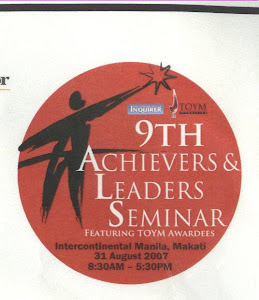
The picture could be a person reaching for what looks like a star. But this is actually the logo used for a the "Achievers and Leaders" seminar. On that day I sat with bankers, journalists, academicians(who also asked for discounts like me), and business tycoons (wow!) that is to hear TOYM (Ten Outstanding Young Men) awardees to talk. There was Bo Sanchez (an inspirational speaker and writer), Maria Ressa (of Channel 2-you remember the Manila Pen issue?), Rico Hizon (of the BBC World), Louie Hernandez (of eTelecare who said that "Filipinos are not cheap. We are just better."), Vivienne Tan (daughter of the tycoon Lucio Tan), Dr. Raquel Fortun (of the Subic rape case), and Butch Jimenez (producer of Muro-Ami).
I didn't hear much about theories. Because there were really more to learn about their singular lives and stories. Here's 2 of those:
1. Bo related the story of 8 siblings who lost their parents. The father was supposedly an NPA and was killed and the mother succumbed to an illness. Left without parents the siblings lived in a mountain with the eldest gathering wood and selling this to buy them food.
Without other means to live the eldest had to scrimp using the matchstick she buys (sounds like the matchstick girl story) to cook their food. One day a neighbor asked for the last matchstick. The eldest to decided to give this after praying "Kayo na po'ng bahala sa amin." The same night they were found by Bo who eventually kept them in an orphanage. The eldest finally became a help in the orphanage by helping others also find a home.
Bo said that he did not pass either the UP, Ateneo or La Salle college exam. But he discovered that he was a good speaker and decided to use this - especially for those who needed conseling and prayer.
2. Dr. Fortun said that when she was little, she wanted to be different. So when she grew up she became a doctor among a family of lawyers. When deciding to go into medicine she said that she really did not have the patience to be with the patients. She would rather be with the dead "who could no longer speak about their death," and the maggots who looked like cheese.
She was schooled in poor UP and taught in poor UP. She would go wherever she was called. One time she was asked to exhume a kid who was killed because she was supposed to be an NPA. Another time she was in East Timor examining cadavers who were killed by goverment soldiers who did not want independence for East Timor. Another time she was cutting a cadaver on top of a door that was placed on a floor using, I think, kitchen knives.
Flashed on the screen, when she was almost through her talk, it showed "I need a job. Hire me."
Of course we laughed, in pain. Because there was really much to do and you could only measure your achievement in terms of emotional growth rather than monetary gain.
The lesson I learned (or re-learned)? That change is what we do, day in and day out, breath in and breath out.
Monday, December 10, 2007

Tuesday, December 4, 2007
Human Rights Violations
Since last week we've been hearing about statements like "from Manila Pen to National Pen", referring to the Trillanes group who staged a coup at the Manila Peninsula and ended up at the National Penitentiary after the bungled coup. There is also news about the journalists being gagged (again) for showing us, blow by blow, what happened at the Pen. The rebel soldiers are angry at the violations made by this incumbent government. The incumbent government wants to punish the journalist violators and the rebel soldiers. Sino ba ang violator?
Check this statistics which I got from a Sociology book - sorry I forgot the name of the author. But he cited a time (?)study on human rights violations and its perpetrators. Read below:
Sectoral Participation in Public Information Activities (1988-2000):
No. of participants
Government officials, employees - 99,282
Rebel returnees, prisoners - 11,379
Students, teachers, youth, school heads - 166,165
Military/ police - 165,018
Barrio residents, officials - 9,985
Religious sector - 1,409
Media - 1,307
Farmers/ fisherfolks - 726
Judiciary - 435
Urban poor - 4,629
NGO - 14,266
Rural/ urban industrial workers - 6,411
Professionals, civilian, general public - 83,545
Multi-sectoral - 228,339
Victims of HR violations (1988-June 2000):
Civilian - 8,374
Rural/ urban industrial workers - 5,189
child, women, student - 2,972
Military/ police - 759
Local officials/ employees - 507
Detainee/ prisoner - 330
Urban poor - 371
Others - 3,372
Alleged Perpetrators of HR Violations (1988-2000):
Police - 8,879
Military - 2,800
Para-military - 1,475
CPP-NPA - 2,298
Civilian - 3,129
Local officials, employees - 2,234
Others - 4,483
Are you surprised at the data? Seems like the more the military and the police attended info-dissemination activities, the more it was likely of them to be HR violators. We hope the trend is not institutionalized.
Check this statistics which I got from a Sociology book - sorry I forgot the name of the author. But he cited a time (?)study on human rights violations and its perpetrators. Read below:
Sectoral Participation in Public Information Activities (1988-2000):
No. of participants
Government officials, employees - 99,282
Rebel returnees, prisoners - 11,379
Students, teachers, youth, school heads - 166,165
Military/ police - 165,018
Barrio residents, officials - 9,985
Religious sector - 1,409
Media - 1,307
Farmers/ fisherfolks - 726
Judiciary - 435
Urban poor - 4,629
NGO - 14,266
Rural/ urban industrial workers - 6,411
Professionals, civilian, general public - 83,545
Multi-sectoral - 228,339
Victims of HR violations (1988-June 2000):
Civilian - 8,374
Rural/ urban industrial workers - 5,189
child, women, student - 2,972
Military/ police - 759
Local officials/ employees - 507
Detainee/ prisoner - 330
Urban poor - 371
Others - 3,372
Alleged Perpetrators of HR Violations (1988-2000):
Police - 8,879
Military - 2,800
Para-military - 1,475
CPP-NPA - 2,298
Civilian - 3,129
Local officials, employees - 2,234
Others - 4,483
Are you surprised at the data? Seems like the more the military and the police attended info-dissemination activities, the more it was likely of them to be HR violators. We hope the trend is not institutionalized.
Monday, November 26, 2007
Silence
There's a beatiful book, written by a woman doctor, entitled "Trauma and Recovery: the aftermath of violence- from domestic abuse to political terror." Although to be traumatized is not really a beautiful experience.
I though I'd write about it because as a woman you can't help thinking about the inequality in this world. In fact, according to the World Health Organization, our lifespan is reduced by 5% for every violence that we experience. And violence does not only refer to the physical abuse, but the verbal, emotional, psychological, sexual and even socioeconomic type of violence that we can think of. Unfortunately, those violated of their rights are silenced. But must we? Or if we already are, must this continue? Here's something to think about and which I'm quoting from that book:
"In order to escape accountability for his crimes, the perpetrator does everything in his power to promote forgetting. Secrecy and silence are the perpetrator's first line of defense. If secrecy fails, the perpetrator attacks the credibility of his victim. If he cannot silence her absolutely, he tries to make sure that no one listens. To this end, he marshals an impressive array of arguments, from the most blatant denial to the most sophisticated and elegant rationalization. After every atrocity one can expect to hear the same predictable apologies: it never happened; the victim lies; the victim exaggerates; the victim brought it upon herself; and in any case it is time to forget the past and move on. The more powerful the perpetrator, the greater is his prerogative to name and define reality, and the more completely his arguments prevail."
Sounds sickening? Yes. But there's a way out. Shout! And create noise - especially collective noise.
I though I'd write about it because as a woman you can't help thinking about the inequality in this world. In fact, according to the World Health Organization, our lifespan is reduced by 5% for every violence that we experience. And violence does not only refer to the physical abuse, but the verbal, emotional, psychological, sexual and even socioeconomic type of violence that we can think of. Unfortunately, those violated of their rights are silenced. But must we? Or if we already are, must this continue? Here's something to think about and which I'm quoting from that book:
"In order to escape accountability for his crimes, the perpetrator does everything in his power to promote forgetting. Secrecy and silence are the perpetrator's first line of defense. If secrecy fails, the perpetrator attacks the credibility of his victim. If he cannot silence her absolutely, he tries to make sure that no one listens. To this end, he marshals an impressive array of arguments, from the most blatant denial to the most sophisticated and elegant rationalization. After every atrocity one can expect to hear the same predictable apologies: it never happened; the victim lies; the victim exaggerates; the victim brought it upon herself; and in any case it is time to forget the past and move on. The more powerful the perpetrator, the greater is his prerogative to name and define reality, and the more completely his arguments prevail."
Sounds sickening? Yes. But there's a way out. Shout! And create noise - especially collective noise.
Sunday, November 25, 2007
Spirit
It was in 1996 when I wrote my article "Mother to an Ayta" (please see my blog). A few days later I got a telegram (uso pa noon). It came all the way from Baguio from a bigtime professor of mine. Bigtime because she had a PhD, she graduated from UP Diliman and had a fellowship in the USA to finish her postgraduate studies. And if you're in class, you had better listen well because she does not only have the "authority" to teach Political Science. She's also not the high school teacher stereotype who "spanks." She's also married to an American (I think he comes from a farming family) who teaches Political Science in UP Baguio then.
One time she assigned us to describe the Philippine electoral process. I'm not sure if I was able to research this in our school library, but I came up with an answer by copying (plagiarizing, actually. ooops!). My History teacher told me then that we had the same type of government like the USA so I presumed we had the same electoral process. My professor asked me to come and see her. Of course I never did. I was guilty. So you could just imagine how I felt holding a telegram that came from her 6 years after graduating. My... But you know what that telegram said?
"Write whenever the spirit moves you." She read "Mother to an Ayta." And she guessed it was me who wrote it though my surname then was already different because I got married already.
I'm writing about this Spirit, not because I believe in spirits. I'm not even the church-goer type. I'm writing because I was reminded by Barbra Streisand ( in a DVD-concert- which I watched over the weekend). I have not tracked down Streisand's love life. But I was touched by her singing "Now that I'm around you" - so soulfully to his son, minus the father who was not in the audience with them.
And I was reminded of how it is to be a woman and a single parent. This is a difficult situation to be in, but at the same time it is liberating. Why? Because you get to discover more your own spirit, you nurture it, you make it soar so high and you linger there. But you never lose your feet on the ground because there's the kids to feed, clothe and give good education to.
And not many women have discovered this. Many of us, women, have subsumed our roles for the sake of children, husband, family and society. And it's really unfair. For how can this world be happier if half of its population live in fear? in desperation? I hope many of us are liberated, by our spirits.... in time.
I
One time she assigned us to describe the Philippine electoral process. I'm not sure if I was able to research this in our school library, but I came up with an answer by copying (plagiarizing, actually. ooops!). My History teacher told me then that we had the same type of government like the USA so I presumed we had the same electoral process. My professor asked me to come and see her. Of course I never did. I was guilty. So you could just imagine how I felt holding a telegram that came from her 6 years after graduating. My... But you know what that telegram said?
"Write whenever the spirit moves you." She read "Mother to an Ayta." And she guessed it was me who wrote it though my surname then was already different because I got married already.
I'm writing about this Spirit, not because I believe in spirits. I'm not even the church-goer type. I'm writing because I was reminded by Barbra Streisand ( in a DVD-concert- which I watched over the weekend). I have not tracked down Streisand's love life. But I was touched by her singing "Now that I'm around you" - so soulfully to his son, minus the father who was not in the audience with them.
And I was reminded of how it is to be a woman and a single parent. This is a difficult situation to be in, but at the same time it is liberating. Why? Because you get to discover more your own spirit, you nurture it, you make it soar so high and you linger there. But you never lose your feet on the ground because there's the kids to feed, clothe and give good education to.
And not many women have discovered this. Many of us, women, have subsumed our roles for the sake of children, husband, family and society. And it's really unfair. For how can this world be happier if half of its population live in fear? in desperation? I hope many of us are liberated, by our spirits.... in time.
I
Thursday, November 22, 2007
Labeling
Did you ever wish, as a parent, you had gifted children - children who could read even before he could go to school? or children who could play the violin like the Promil commercial? If you don't, or if you have not discovered yet that you do, read this blog. My eldest of 12 years old blurted last night that his teacher is a bully. This lunchtime his teacher told them in class(they're in section 7) that they will not pass the National Aptitude Test and therefore had to stay 5 more years in elementary. Goodness!!! But here's the study I was talking about before I talk to my son's teacher - or perhaps write their Principal.
In a ghetto area in the USA in the 1960s, a study about labeling of schoolchildren was conducted. The children's status from kindergarten up to Grade II was tracked down. Specifically, the teachers' practice of labeling its students was looked into. During kindergarten, the teacher placed its students in tables 1, 2 and 3. The placement was based on physical appearance, body odor, school language used, socioeconomic status and family size, and whether they were "fast" or "slow" learners.
Those in table 1 were the teacher's favorite - they were "fast" learners, were clean in appearance and odor, used standard American English, had high economic status and small family size. The farther the table, the "worse" the status. Amazingly, the children followed the way the teachers treated them. Those in table 1 were "respected." While those in table 2, and worse in table 3 had behavioral problems and low self-esteem.
There were 30 kindergarten students. This was reduced to 18 by the time the kids reached Grade 1. The teacher during this grade level followed a similar classification of the students and treated the students similar to the kindergarten teacher.
By the time the students reached Grade 2, there were only 10 of them.
You ask why? There's a theory we call Labeling. It says that labeling is a "self-fulfilling prophecy" - the more the kids are labeled "bad," the more they actually turn into "bad" kids. And unfortunately, the kids followed what the adult did. The worse part here is if the "bad' kid comes home to a non-ideal family.
The moral lesson? Be careful when you label children, or perhaps even adolescents and adults- they more likely become what we want them to become. So instead of destroying someone's life, try finding the "giftedness' of other people - be they young, not so young or old. Here in the Philippines, Ibon Foundation reported in 2004 that only 1/10 Filipino child is able to finish tertiary education.
In a ghetto area in the USA in the 1960s, a study about labeling of schoolchildren was conducted. The children's status from kindergarten up to Grade II was tracked down. Specifically, the teachers' practice of labeling its students was looked into. During kindergarten, the teacher placed its students in tables 1, 2 and 3. The placement was based on physical appearance, body odor, school language used, socioeconomic status and family size, and whether they were "fast" or "slow" learners.
Those in table 1 were the teacher's favorite - they were "fast" learners, were clean in appearance and odor, used standard American English, had high economic status and small family size. The farther the table, the "worse" the status. Amazingly, the children followed the way the teachers treated them. Those in table 1 were "respected." While those in table 2, and worse in table 3 had behavioral problems and low self-esteem.
There were 30 kindergarten students. This was reduced to 18 by the time the kids reached Grade 1. The teacher during this grade level followed a similar classification of the students and treated the students similar to the kindergarten teacher.
By the time the students reached Grade 2, there were only 10 of them.
You ask why? There's a theory we call Labeling. It says that labeling is a "self-fulfilling prophecy" - the more the kids are labeled "bad," the more they actually turn into "bad" kids. And unfortunately, the kids followed what the adult did. The worse part here is if the "bad' kid comes home to a non-ideal family.
The moral lesson? Be careful when you label children, or perhaps even adolescents and adults- they more likely become what we want them to become. So instead of destroying someone's life, try finding the "giftedness' of other people - be they young, not so young or old. Here in the Philippines, Ibon Foundation reported in 2004 that only 1/10 Filipino child is able to finish tertiary education.
Oxygen
Did you know that 1 mature tree can give-off oxygen for 7 persons? The data came from an article by Tebtebba Foundation. Perhaps it won't be long for oxygen to be sold in bottles. So plant trees before somebody patents oxygen in bottles.
Monday, November 19, 2007
Politics in the Hospital
Teaching is a dialogue. Students learn from teachers. And teachers learn from students. Otherwise, there is no teaching. But sometimes you get surprised with what you learn from your students. I did. And I was horrified.
Years back, I innocently required my Nursing students -probably all of whom wanted to work abroad after graduation- in our Philippine Government and Constitution subject to come up with a paper about Politics in the Hospital. This means telling stories about their experiences during hospital duty which they consider as "political."
Of course we had to define first what politics is. Well, I got all the answers related to politics. But I summarized its definition to its simplest nature which is "the ability of A to make B do something which B would not have otherwise done." Sounds clear enough. But I wanted the concept not just to be defined by them but to let the concept eventually sink down their head and heart (even after taking this subject) and perhaps influence them to decide to help our country first rather than work abroad after graduation. Here were some of their stories:
1. There was 1 baby patient who was looked after by her mother and her 12-year old brother in the Pediatric Ward. Hungry, the mother decided to have her younger son to buy them food. Having bought food outside the hospital, because the hospital canteen was already closed and food was much cheaper, the boy went outside the hospital. He, however, never returned to their ward because Visiting Hours was over. The security guard gave the food to the mother but disallowed the boy to enter the hospital.
2. A patient suffering from pain from his pelvis and downwards was admitted in the hospital. Not knowing yet the cause of his pain, the doctor told the wife to make the patient to undergo several tests. Upon knowing the amount of 1 ultrasound, which was P9,000, the wife decided not to have this. Because no payment was made, no ultrasound was taken. Nurses were described to be texting and laughing away their time. Next day, the patient died.
3. One patient was going into shock. Horrified, although disallowed, the student-nurses wanted to perform CPR to revive the patient. When the students informed the nurses on duty about this they were told that the patient's relative already signed some papers stating that DNR will be performed. So what's DNR? DO NOT RESUSCITATE! That's because the patient does not have the means to pay for their bills.
4. A statistic supposedly observed in the hospital is 1 syringe = 1 patient. Out of poverty, or for some other reason this hospital practice is to use 1 syringe for 2-3 patients.
5. Another poor patient was admitted in the hospital. An external fixator was placed in him to keep his broken bones intact. This device, however, has to be removed. Without the money to buy anaesthesia, the fixator was removed - just like that, without the anaesthesia.
Horrified? Who wouldn't be? Did I learn? Yes, and I did painfully. After reading all the papers my students submitted I thought - maybe thinking about them not working abroad is too far enough to be given a thought. Some form of "debriefing" for the students would have helped them understand better the horrors in the hospital. But is this available? Not really. About 2 years ago, government only allotted about 35 centavos for the healthcare of 1 Filipino citizen.
Years back, I innocently required my Nursing students -probably all of whom wanted to work abroad after graduation- in our Philippine Government and Constitution subject to come up with a paper about Politics in the Hospital. This means telling stories about their experiences during hospital duty which they consider as "political."
Of course we had to define first what politics is. Well, I got all the answers related to politics. But I summarized its definition to its simplest nature which is "the ability of A to make B do something which B would not have otherwise done." Sounds clear enough. But I wanted the concept not just to be defined by them but to let the concept eventually sink down their head and heart (even after taking this subject) and perhaps influence them to decide to help our country first rather than work abroad after graduation. Here were some of their stories:
1. There was 1 baby patient who was looked after by her mother and her 12-year old brother in the Pediatric Ward. Hungry, the mother decided to have her younger son to buy them food. Having bought food outside the hospital, because the hospital canteen was already closed and food was much cheaper, the boy went outside the hospital. He, however, never returned to their ward because Visiting Hours was over. The security guard gave the food to the mother but disallowed the boy to enter the hospital.
2. A patient suffering from pain from his pelvis and downwards was admitted in the hospital. Not knowing yet the cause of his pain, the doctor told the wife to make the patient to undergo several tests. Upon knowing the amount of 1 ultrasound, which was P9,000, the wife decided not to have this. Because no payment was made, no ultrasound was taken. Nurses were described to be texting and laughing away their time. Next day, the patient died.
3. One patient was going into shock. Horrified, although disallowed, the student-nurses wanted to perform CPR to revive the patient. When the students informed the nurses on duty about this they were told that the patient's relative already signed some papers stating that DNR will be performed. So what's DNR? DO NOT RESUSCITATE! That's because the patient does not have the means to pay for their bills.
4. A statistic supposedly observed in the hospital is 1 syringe = 1 patient. Out of poverty, or for some other reason this hospital practice is to use 1 syringe for 2-3 patients.
5. Another poor patient was admitted in the hospital. An external fixator was placed in him to keep his broken bones intact. This device, however, has to be removed. Without the money to buy anaesthesia, the fixator was removed - just like that, without the anaesthesia.
Horrified? Who wouldn't be? Did I learn? Yes, and I did painfully. After reading all the papers my students submitted I thought - maybe thinking about them not working abroad is too far enough to be given a thought. Some form of "debriefing" for the students would have helped them understand better the horrors in the hospital. But is this available? Not really. About 2 years ago, government only allotted about 35 centavos for the healthcare of 1 Filipino citizen.
Subscribe to:
Posts (Atom)
.jpg)

.jpg)